
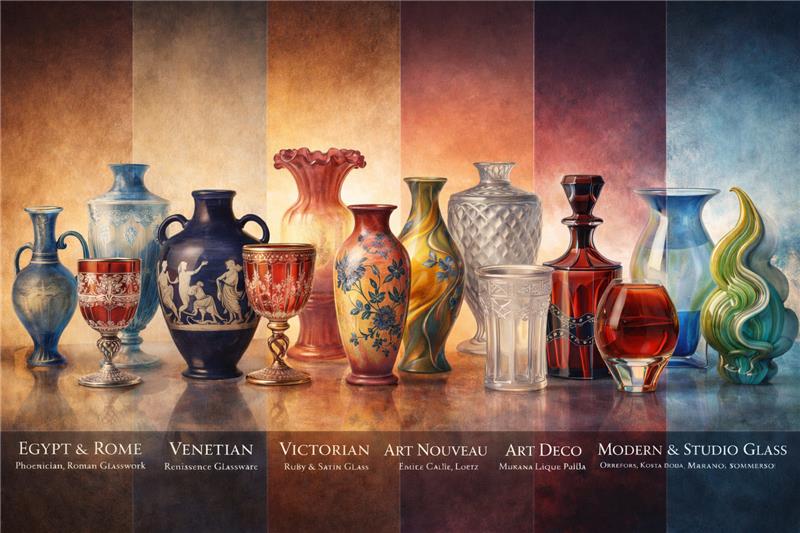
From Sand to Sculpture: The Evolution of Decorative Glass
Glass is one of the most remarkable materials humans have ever mastered. Made primarily from silica (sand) fused with soda and lime at extremely high temperatures, it has a fascinating history that spans thousands of years and multiple civilizations.
Over time, glass has evolved into one of the most expressive mediums in decorative art. Its story is not simply a technical history; it reflects changing civilizations, artistic ideals, and hard-won technological breakthroughs.
Understanding this evolution helps collectors, historians, and designers see how styles transform while continuing to borrow from the past.
Ancient Origins: The Birth of Glass (c. 2500 BC – 500 AD)
The earliest known glass objects (typically beads) emerged from Mesopotamia and Egypt around 2500–2000 BC. Decorative glassmaking developed later, with early civilizations such as the Egyptians and Phoenicians creating small glass vessels using a core-forming technique: winding molten glass around a removable clay core.
Glassblowing was developed in the eastern Mediterranean during the first century BC and spread rapidly throughout the Roman Empire. This innovation allowed glass to be produced faster and in far more complex shapes than before. Roman glassmakers also created extraordinary luxury objects, including cameo glass, the most celebrated example being the Portland Vase, a violet-blue vessel layered with carved white glass figures, now housed in the British Museum. For the first time, glass became both a practical and genuinely artistic medium.
Venetian Mastery: Renaissance Innovation (1400–1700)
After the Middle Ages, glassmaking reached new heights on the island of Murano, just off Venice, the undisputed center of European glass innovation. In 1291, the Republic of Venice ordered all glassmakers to relocate to Murano, officially to reduce the fire risk posed by furnaces in the wooden city, though the move also served to protect closely guarded trade secrets.
Venetian craftsmen developed cristallo, an exceptionally clear glass that closely mimicked rock crystal. They also invented intricate decorative techniques such as latticino and filigrana, in which threads of white or colored glass were embedded and twisted inside transparent vessels.
Murano glass became a symbol of wealth and prestige across Europe, and Venetian glassmakers zealously guarded their methods, in some cases under threat of severe punishment for those who revealed secrets to outsiders. However, by the 1600s, Northern European glasshouses had begun copying Venetian techniques, gradually weakening Murano’s monopoly.
The Transitional Period (1650–1830)
During the 17th century, Venetian glassmakers began leaving Murano, sometimes clandestinely, as other countries recruited them. Glasshouses across Europe began producing work in the “façon de Venise” (in the Venetian style), disseminating Murano’s techniques across the continent.
The most significant innovation of this era came in 1674, when English merchant and glassmaker George Ravenscroft patented lead crystal glass. Heavier and more brilliant than anything produced before, it had a higher refractive index that made it ideal for deep cutting and engraving. Ravenscroft’s discovery helped shift the center of fine glassmaking to England and marked an early stage in the industrialization of the craft.
Victorian Experimentation (1830–1900)
The Industrial Revolution transformed decorative glass production on every scale. New furnaces and manufacturing techniques allowed factories to experiment with color and form in ways previously impossible. Victorian glassmakers produced a dazzling variety of materials and effects: cranberry glass made with gold chloride; satin and opalescent glass with soft matte finishes; and cut overlay glass, in which layers of colored glass were carved away to reveal contrasting hues beneath.
Bohemian glasshouses such as Moser and Harrach became internationally renowned during this period. Pressed glass also emerged widely, democratizing glass ownership through accessible mass production and bringing decorative wares into everyday homes for the first time.
The Art Glass Movement (1880–1910)
This transitional period bridges industrial production and the aesthetics of Art Nouveau. Ambitious studios, including those of Louis Comfort Tiffany, Steuben, Mount Washington, and Thomas Webb, hired chemists and artists to push the boundaries of what glass could become.
The innovations they produced were remarkable: iridescent glass, satin glass, Burmese glass, cased and cut overlay glass, and acid cameo carving. The art glass movement elevated industrial decorative ware into deliberately artistic production, laying the groundwork for what would follow.
Art Nouveau: Glass as Sculpture (1890–1915)
Art Nouveau elevated decorative glass into a true art form. Inspired by the natural world, artists created flowing, organic designs featuring plants, insects, and dreamlike landscapes. Masters such as Émile Gallé, Daum, Loetz, and Tiffany Studios experimented with cameo carving, acid etching, and iridescent finishes, techniques that blurred the line between fine craft and fine art, and continue to be among the most collectible glass works in the world.
Art Deco and Modern Design (1920–1940)
In contrast to the organic curves of Art Nouveau, Art Deco embraced geometry and modernism. Clean lines, symmetrical patterns, and bold sculptural forms defined the style. René Lalique’s frosted glass sculptures and architectural pieces captured the optimism and industrial energy of the early twentieth century, while Czech designers and firms such as Heinrich Hoffmann and Curt Schlevogt excelled in highly refined pressed glass.
Scandinavian Modern and the Studio Glass Movement (1950–Present)
After World War II, decorative glass entered a new phase defined by modern design and artistic experimentation. Scandinavian glasshouses such as Orrefors and Kosta Boda championed simplicity, clean forms, and subtle color, bringing a quiet elegance that stood apart from the ornate traditions of earlier eras.
Then, in 1962, two groundbreaking workshops at the Toledo Museum of Art, led by artist Harvey Littleton and glass engineer Dominick Labino, changed everything. They demonstrated that artists could work with molten glass in small studio furnaces rather than relying on industrial factories. This launched the Studio Glass Movement, shifting glass from purely decorative production into a medium for individual artistic expression.
Iconic talents such as Dale Chihuly, Marvin Lipofsky, and Richard Marquis helped define this period and brought the movement into the mainstream of contemporary art, with works that now command serious attention from collectors and museums worldwide.
A Continuous Transformation
From Roman workshops to modern studios, decorative glass has never stopped evolving. Each era introduced new techniques, new aesthetics, and new ideas about what glass could be. What began as small ancient vessels has grown into monumental sculptures, architectural installations, and treasured works of art.
Yet at its core, the magic remains the same: a material born from sand, shaped by fire, and refined by human imagination.
Recent Posts
Coin Authentication: A DIY Guide for Collectors
Preserving History: Expert Tips for Caring for Civil and Revolutionary War Militaria

Coin-Ops: Relics of Yesterday, Treasures of Today
All Categories
Sell With Confidence
Roger G. Jacobsen Paperweight Collection Part 1
3d 11h 13m 9s
The best auction finds don’t wait around.
Be the first to see what’s coming up—sign up for exclusive previews and expert insights.