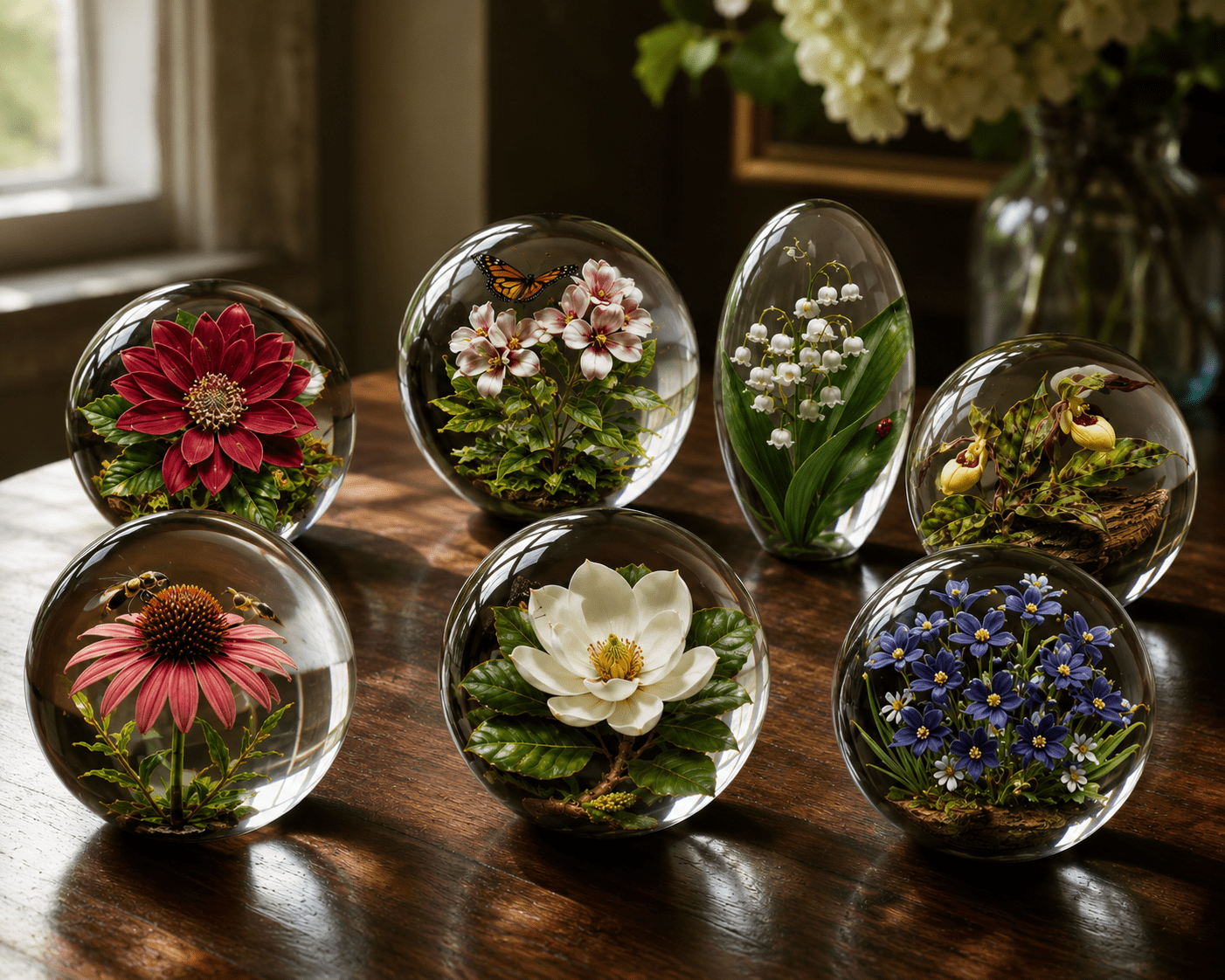
There is a moment that happens to almost everyone who encounters a Paul Stankard paperweight for the first time. You lean in closer than you intended to. You look for the seam, the trick, the invisible mechanism that allowed a honeybee to end up perfectly suspended inside a ball of solid glass, hovering above a cluster of wildflowers whose petals are thinner than paper and accurate enough to make a botanist stop and stare.
Then someone tells you those flowers were never real. Every petal, every filament of root, every tiny figure tangled in the soil beneath the plant was sculpted by hand from colored glass rods, using nothing but flame and a pair of tweezers and fifty years of obsessive practice.
That moment of disbelief is exactly what Paul Stankard has spent his career engineering.
From Laboratory Bench to Studio Floor
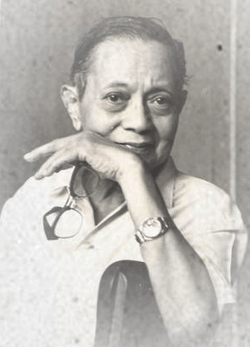
Stankard was born in 1943 in North Attleboro, Massachusetts, the second of nine children in an Irish Catholic family. School was hard for him in ways that took decades to fully understand. He graduated near the bottom of his class, was assigned a low IQ score by a system that had not yet developed a vocabulary for dyslexia, and carried the weight of that judgment for years. The path his father pointed him toward, a technical program in scientific glassblowing at Salem County Vocational Technical Institute in New Jersey, turned out to be the one place where his hands and his eye could outrun the written word.
He spent the next decade making laboratory instruments, the kind of precise, unforgiving work that leaves no room for approximation. As head of the glass department at Rohm and Haas in Philadelphia, he was skilled and respected and quietly miserable. The work was exacting but empty. So in his garage in 1969, he started making flowers.
He took those flowers to a craft exhibition on the boardwalk in Atlantic City in 1971. An art dealer named Reese Palley saw them and offered him $250 a week to quit his job and make glass full time. Stankard was twenty-eight years old. He said yes.
That decision changed what a paperweight could be.
What Makes a Stankard Unlike Anything Else
The tradition Stankard was stepping into was a noble one. French factories like Baccarat and Saint Louis had been producing millefiori and lampwork paperweights since the 1840s, and those pieces remain among the most treasured objects in the decorative arts. But they operated within a certain visual grammar: flowers that suggested flowers, patterns that pleased the eye, craftsmanship that demonstrated mastery of the form.
Stankard was after something different. He wanted organic credibility. He studied actual plants, actual root systems, actual insects. He spent years developing techniques to reproduce specific species of wildflowers with the kind of accuracy you would expect from a scientific illustration. The result was something that did not look like a representation of a flower. It looked like the flower itself had been captured mid-bloom and sealed in glass at 2,000 degrees Fahrenheit.
He also introduced something no one had put in a paperweight before. Hidden among the roots of his botanical compositions, almost invisible unless you know to look, are small humanoid figures he calls root people. They are based on illustrations from medieval herbal books, tiny earth spirits tangled in the soil, and they transform what could have been a virtuoso technical exercise into something stranger and more resonant. Alongside these figures, Stankard sometimes encases single words, “seeds,” “pollen,” “decay,” embedded in the glass like whispered captions to a poem about the life cycle of everything that grows.
He has spoken about his relationship to the work of Walt Whitman in terms that make this clear. His goal was not botanical illustration. It was to do in glass what Whitman did with words: to find the spiritual inside the physical, to insist that a wildflower contains a universe if you are patient enough to look at it properly.
The Studio Glass Movement and Why Stankard Matters to It
To understand where Stankard sits in the broader arc of American art, it helps to know a little about the studio glass movement that emerged in the early 1960s. Before that point, glass as a medium belonged almost entirely to factories. Individual artists did not make glass objects. They designed them, and factories produced them, or they did not exist.
Harvey Littleton changed that at a 1962 workshop at the Toledo Museum of Art, where he demonstrated that an artist could work with molten glass in a small studio setting. That moment is generally treated as the birth of the American studio glass movement, and it eventually produced some of the most significant decorative art of the twentieth century.
Stankard came to this world as an outsider. He was not a fine arts graduate. He was a technical glassblower who had taught himself to look at wildflowers. But the precision his training had given him, and the artistic vision his years of self-directed learning had built, allowed him to do things with flameworking that no one else was doing. He elevated a form that much of the art world had dismissed as a Victorian curiosity into something that belonged in museums. His work is now held in more than 70 institutions worldwide, including the Smithsonian, the Corning Museum of Glass, and the Metropolitan Museum of Art.
The Corning Museum called him a living master. The Smithsonian’s James Renwick Alliance gave him its Masters of the Medium Award. The Glass Art Society honored him with its Lifetime Achievement Award. He received two honorary doctorate degrees from institutions that once would have had no use for someone with his educational history.
What Stankard’s Work Does at Auction
The market for Stankard’s work has developed the kind of consistency that serious collectors look for. Smaller or earlier pieces, those with simpler botanical arrangements or modest compositions, typically find buyers in the $1,000 to $3,000 range, making them a genuine entry point into contemporary studio glass without requiring the budget of a major institutional collector.
Mid-range pieces, which represent the bulk of the market, generally land between $4,000 and $9,000. These tend to involve more complex floral clusters, deeper compositions, or the “root people” and embedded word elements that distinguish his mature work from his earlier output.
His most ambitious pieces, particularly the columnar and rectangular block forms that offer multiple viewing angles and carry entire botanical ecosystems inside them, regularly exceed those figures at auction. A 1997 rectangular paperweight titled Botanical and Earth Spirit Weight set a platform record at Habatat Galleries in January 2022, selling for $19,000 plus buyer’s premium. A cobalt-based Earth Spirit piece surpassed its pre-sale estimate of $6,500 to $7,500 to reach $10,500 plus premium in September 2021. These are not anomalies. They are the ceiling of a market that has proven remarkably steady over decades.
Provenance matters with Stankard as it does with any serious collecting field. Pieces acquired directly from WheatonArts in Millville, New Jersey, where he has been an artist in residence for years, or through established galleries, carry documentation that supports both authentication and value. Signed and dated examples, particularly those with his characteristic cane signature, are the standard for serious collecting.
What to Look for When You Encounter a Stankard
Every piece is unique and hand-signed. The signature, usually etched into the lower edge or encoded in a cane within the composition, is one of the first things an informed buyer checks. The documentation matters too: many pieces come with gallery certificates or original purchase records that trace the ownership history.
Beyond authentication, the elements that drive value in Stankard’s work are complexity and subject matter. Compositions featuring multiple botanical species, root people, insects like bees or damselflies, and his embedded words represent the fullest expression of his artistic vision, and the market reflects that. Simpler pieces from his earlier years, while still genuine Stankard, lack the layered symbolism that has made his work so enduring.
The form also matters. His spherical paperweights are the most recognized format and the most widely collected. His upright botanicals and rectangular block forms are rarer, offer more visual complexity, and have historically commanded stronger prices at auction.
A Legacy That Belongs in the Conversation
Paul Stankard did something genuinely difficult. He took an object that most people associated with office desks and Victorian drawing rooms and made it a vehicle for serious artistic expression without apologizing for the form or abandoning what made it distinctive. He did not try to make a paperweight that looked like something else. He made the paperweight itself mean more.
At 81, he is still at his bench, still studying flowers, still finding new ways to trap the world inside a few inches of glass. His books, his teaching, and his decades of work at WheatonArts have shaped a generation of flamework artists who are carrying what he started into new territory.
For collectors, that history matters as much as the aesthetics. Owning a Stankard is not just owning a beautiful object. It is owning a piece of the argument he has been making his entire career: that the small, intricate, and handmade can hold as much meaning as anything hanging on a museum wall.
Given the evidence of the last fifty years, it is an argument he has already won.
Blue Box Auction Gallery is hosting an upcoming paperweight auction featuring a curated selection of collectible and fine glass works. If you have a Stankard or similar studio piece you are considering consigning, now is a good time to inquire further.