Few artists become inseparable from the visual identity of a nation. Fernando Cueto Amorsolo is one of them.
Born in Manila in 1892, Amorsolo became one of the most celebrated painters in Philippine history and was later named the first National Artist of the Philippines. His work is often described through one defining phrase: the “Painter of Philippine Sunlight.” It is an appropriate title, but it only begins to explain why his paintings remain so admired worldwide by collectors, museums, and the Filipino public.
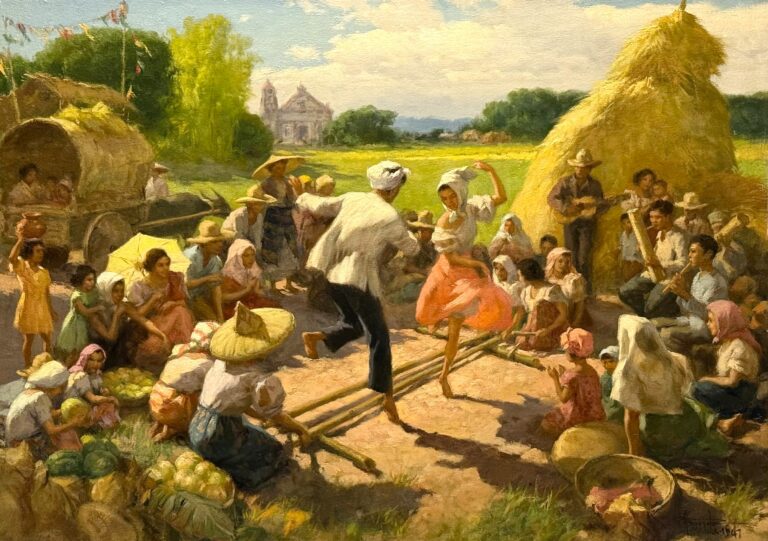
Amorsolo’s art is filled with light, not merely as illumination, but as atmosphere, memory, and national character. His best-known works depict rural life: rice planting, harvesting, women carrying baskets, families at work, fiestas, village scenes, musicians, dancers, farmers, and landscapes glowing beneath a tropical sky. These were not accidental subjects. They became the foundation of his artistic language.
His childhood years in Daet, Camarines Norte, exposed him to the rhythms and imagery of provincial life. That world stayed with him. Even after formal training in Manila and exposure to European painting traditions, Amorsolo returned frequently to the Philippine countryside as his great subject. He painted labor without making it bleak. He painted beauty without making it empty. His rural figures often appear dignified, graceful, and composed, set within landscapes that feel abundant and alive.
One of Amorsolo’s great technical achievements was his use of light and shadow. His backlit figures, warm skies, and glowing fields gave his paintings an instantly recognizable quality. This handling of light was not simply decorative. It allowed him to create drama, depth, and emotional warmth. A figure might stand against the sun with a luminous outline; a field might open into a golden haze; a simple daily task might be elevated into something almost ceremonial.
That idealized quality has long been both admired and debated. Some critics have argued that Amorsolo’s countryside can appear too harmonious, too removed from hardship. But that criticism also points to why the paintings endured. Amorsolo was not only recording rural life. He was shaping an image of Filipino identity, one rooted in work, family, land, sunlight, and cultural continuity.
His career unfolded during a period of enormous upheaval: American colonial rule, the formation of modern Philippine national consciousness, the Second World War, occupation, destruction, and postwar recovery. His wartime works, which include darker scenes of violence and suffering, show that Amorsolo was fully aware of national trauma. But his rural paintings present a different kind of testimony. They preserve the world that war threatened to erase.
This contrast gives his work unusual emotional range. The sunny rice fields and village gatherings are not merely pretty pictures. Seen against the broader sweep of Philippine history, they become images of survival and pride. They show a culture insisting on continuity.
Amorsolo was also extraordinarily prolific. His output included paintings, sketches, studies, portraits, historical scenes, illustrations, and commercial work. His popularity during his lifetime was considerable, and his reputation only expanded after his death in 1972. Today his work can be found in major Philippine collections and museums, and his paintings remain highly sought after in the international art market.
For collectors, Amorsolo represents several things at once. He is a major modern Philippine artist. He is a painter of national memory. He is a technically gifted master of light. He is also one of the rare artists whose work carries immediate emotional recognition among those connected to Philippine heritage.
This is why Amorsolo continues to matter.
His paintings are not simply scenes of farmers, dancers, fruit sellers, or village life. They are visual essays on place and belonging. They invite viewers into a world of light, labor, land, and community. They remind us that art can become a vessel for national identity, and that beauty, when handled with conviction, can become a form of cultural memory.
More than fifty years after his death, Fernando Amorsolo’s work continues to glow, not only on canvas, but in the imagination of the Philippines and its global diaspora.