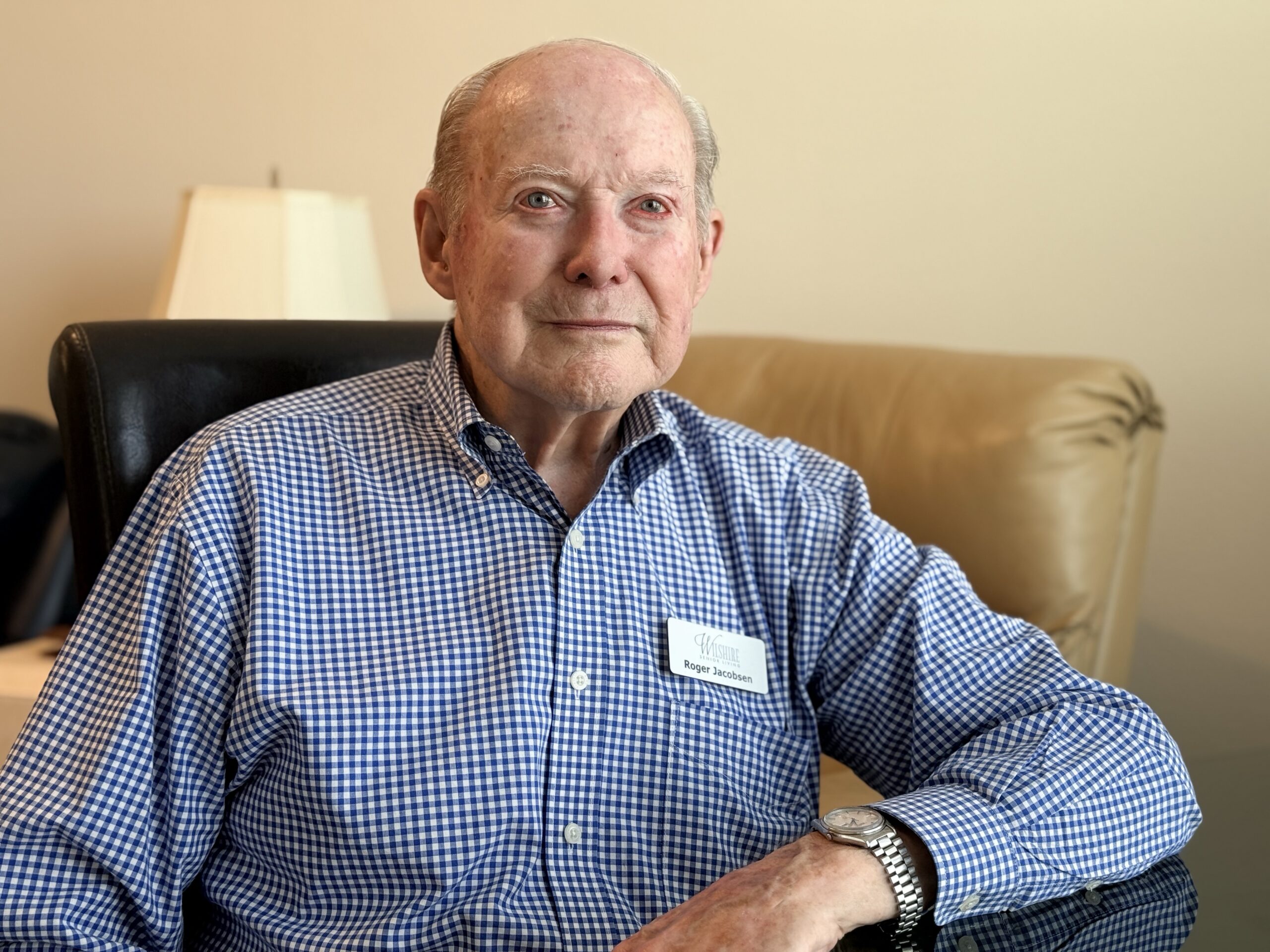
Fifty Years Among Paperweights: A Conversation with Roger G. Jacobsen
Roger G. Jacobsen has spent more than fifty years around paperweights, first as a collector, then as a dealer under the name Paperweights of Quality, and for nearly three decades as the founder and head of the New England chapter of the Paperweight Collectors Association. Ahead of the auction of his collection, we sat down with him to talk about how it all started and what he has learned along the way.
How It Started
Q: What was the first paperweight you ever picked up, and where were you?
I was stationed at Wright-Patterson Air Force Base in Dayton, Ohio. Ohio is a big glass area, and there were several big auction houses not too far away. That is where I bought my first two weights, not knowing for sure just what they were, but I liked them. Both were early Saint-Louis pieces. A lot of the Saint-Louis weights made in that period were not even marked or dated. It was not until the early 1970s that they really started marking and dating more, and that was because of Paul Jokelson, who was getting French makers to make weights again after it had become something of a dying art over there.
Q: Did someone bring you into the hobby, or did you find your own way to it?
That auction is where I started. After that I began writing to different paperweight makers to try to become a dealer. I had gone to the paperweight convention in Chicago in 1972, and when I retired from the Air Force in 1973, I got out and got a lot more involved.
Q: What did prices look like back then?
A mushroom weight went for about $120 in the early 1970s. Baccarat also made small corona weights, just circles of canes, maybe two inches across, and those went for fifteen to twenty five dollars. Every year the prices kept climbing. By the 1990s a mushroom weight that used to be $120 was going for six or seven hundred dollars.
Building Paperweights of Quality
Q: Where did the name of your business come from?
I just picked it because it worked
Q: How did the antiques side of things start?
I was stationed at Barksdale Air Force Base in Shreveport, Louisiana, and my next door neighbor’s husband had been a wealthy man who collected a lot of antiques. He passed away, and she moved into a smaller house next to me. Her garage was full of furniture and things, and since I did not have a dining room table at the time, she told me to just take her table and store the rest of her things for her. I learned a great deal about antiques from her, and that would have been around 1971 to 1973. I had a partner when I first opened a shop, but he wanted to branch into other things and I kept spending on paperweights, so after about three years we went our separate ways.
Q: What were the antique shows like in those early years?
New Haven was a big show that had been running for about fifty years. When they expanded it into the old gymnasium space, I started showing there too. I would pack everything, weights and antiques both, into about thirty of those heavy duty waxed cardboard boxes that used to be made for shipping turkeys. Because of the quality of what I had, I kept working my way up, and by the time that show closed, I had the second booth from the entrance.
Q: Where did you find some of your best pieces outside of the manufacturers themselves?
A good friend of mine, a real picker with a great eye for antiques, had a three story house that was packed floor to ceiling. He had a bathtub on the third floor full of beautiful sterling silver, and an entire room of nothing but rolled up antique carpets. He had been a dealer himself at one point but was getting older and wanted to cut down, so a lot of my best material came through him.
Writing for the PCA Bulletin
Q: What got you started writing for the bulletins?
The Bulletin editor was always asking people to contribute, and I had already been giving talks at chapter meetings, on Union glass in particular, so it was a natural next step. My first piece was around 1975 or 1976.
Q: In 1979 you wrote a solo piece on Orient and Flume, the only article with your name alone. How did that connection start?
Through a collector I sold weights to in California. His wife had picked up a few Orient and Flume pieces almost by accident, and that is how I met the man behind it, Jay Gustin. He had built it into a real operation, three factories supplying pieces that were wholesaled through shops in Los Angeles, Denver, New York, and Atlanta. We became close friends, and that is how I ended up dealing so many of their paperweights and why the article came from a real place.
Q: A number of your other articles were written with Bernard Drabek. How did that partnership begin?
I met Ben through a woman I had been seeing while stationed in Germany. After I got back to the States she tracked me down and invited me to a party at his place, and that is where we met and became friends. We went into a number of projects together over the years, including several of the bulletin articles.
The Perthshire Friendship
Q: You were close with Stuart Drysdale of Perthshire Paperweights. What was that relationship like?
Stuart would come over from Scotland with a suitcase of samples to sell to dealers around the country, and he would stay at my place for two or three days each trip to get over the time change. We would visit, and then he would go make the rounds of the other states before coming back through on his way home. I still have three of those suitcases, full of samples from 1978, 1979, and 1980, weights that were made as samples for what Perthshire would put into production the following year. His wife was German and loved to cook, so whenever he was here we would go to the market and load up on spices and things she could not get back home. He would carry those back to her.
Building the New England Chapter
Q: How did the New England chapter of the PCA get started?
I started putting the idea together around 1975, talking to people and getting them interested, and we held our first meeting in 1977. I ran it for 28 years after that. We grew past 200 members, with as many as 186 people at a single meeting. Finding a hotel that could hold everyone got harder every year, because we needed room for the meeting itself, the lectures, a luncheon, and space for the dealers to set up.
Q: What did a typical meeting look like?
We would meet a few times a year on a Saturday, start with coffee and donuts, have a speaker in the morning, usually an artist or someone with expertise, then a luncheon together at noon, another speaker in the afternoon, and the dealer show after that. In the early years we actually would not let the dealers sell until the afternoon, because I did not want it to look like I was running the chapter for my own benefit.
Q: You eventually handed the chapter off. To whom?
To a friend of mine named Frank Keeney, a retired schoolteacher I had met at shows. He was not especially serious about paperweights when I met him, but I brought him along into better quality pieces and got him involved in the organization, and eventually he took it over.
A 50 Pound Weight and a Bowling Bag
Q: Tell me about the giant weight presented to Paul Jokelson.
Jokelson founded the organization in 1952 and had spent years arranging for French makers’ weights to be brought into the United States, so at a convention in Chicago they presented him with an enormous Saint-Louis piece, something in the 50 to 60 pound range. Other big collectors wanted one like it, and Saint-Louis eventually agreed to make ten more. I ended up with one and sold it to a collector in California. Rather than risk shipping something like that, I flew out there with it myself, in a bowling bag.
Q: There is also a story about the PCA's logo changing from a bird's nest to a crown. What happened there?
The bird’s nest had been the PCA logo for a long time, tied to a bird’s nest weight that Jokelson himself had found in France for almost nothing. When a new president took over, he and the previous leadership were not on the best of terms, and the logo was changed to a crown, which is what they still use. I will leave the politics of it there. What I will say is that Jokelson’s original bird’s nest weight sold for a serious price at Sotheby’s when his collection went up for auction, and a bird’s nest weight turned up on display at a show just a couple of weeks ago.
Reading a Weight
Q: How do you tell who made a piece just by looking at it?
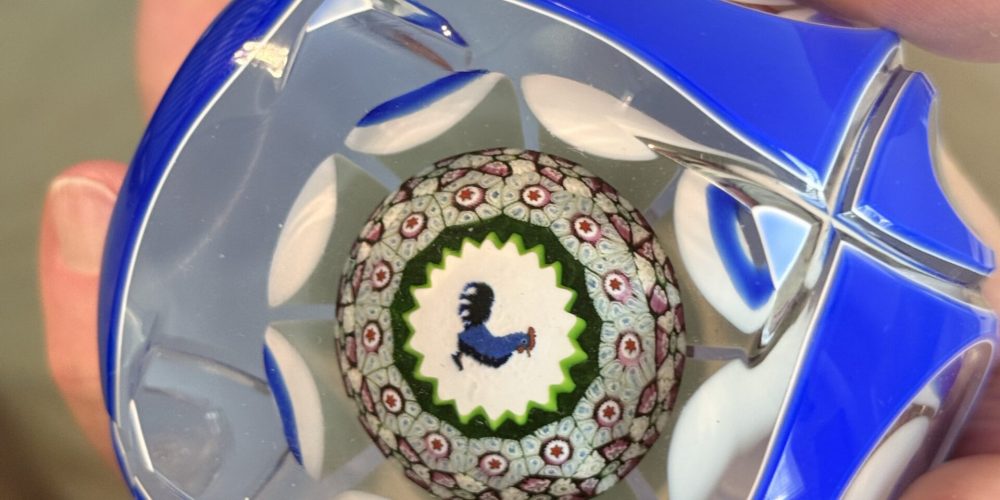
You learn to read the canes. Different makers organized their canes differently, and the small figure canes give a lot away. Baccarat, for instance, produced a couple dozen different figure silhouettes over the years, often built with one central figure surrounded by smaller canes. Once you know what to look for in the shape and arrangement of the canes, you can often tell who made a piece and roughly when.
Q: Walk me through how a weight actually gets made.
Take a silhouette cane. They would press a small amount of colored glass into a mold to get the figure, then build colored glass up around it into a piece that might start out six inches across. From there they heat it and stretch it down until it is almost pencil sized, and that becomes the cane. Lampwork flowers are even more demanding. Every petal, every leaf, every stem is made individually and then assembled like a puzzle. The whole time you are working with molten glass, and if you lose control of the heat for even a moment, the piece is gone. There is nothing you can do to save it once that happens. It takes years for an artist to really master that kind of heat control.
What He Loves Most
Q: Millefiori, lampwork, or sulfides. What draws you in?
Lampwork and canes, both. I never cared as much for sulfides, even though I handled plenty of them. Baccarat is actually the maker that brought sulfides back into the market, starting with an Eisenhower piece around 1970 to 1972. That led to a whole series they called the great leaders of the world, made in both regular and overlay versions. Other companies saw it selling and jumped in too, and between them they made something like five thousand pieces. The market could not absorb that many, so the extras ended up dumped into other channels for ten or fifteen dollars apiece. It gutted that whole segment of the market.
Q: Is there a piece in your own collection you would never sell?
A Clichy weight that is technically damaged. At some point in its history the base was cut down, but the top is still covered in beautiful Clichy roses. I have known it was damaged since the day I found it, and it does not matter. The quality of those roses is the only argument that has ever mattered to me on that piece.
The Hunt
Q: Is there a piece you spent years looking for and never found?
I always liked American weights, and Mount Washington pieces in particular are very rare and hard to come by. I spent a long time hunting for a good one. I thought I had found one once, but the quality was not quite there, and the genuine ones were both scarce and expensive.
Q: There is a well known story about someone buying a paperweight at a yard sale for a dollar and later selling it at Sotheby's for close to thirty thousand. Anything like that ever happen to you?
Nothing quite that dramatic, but every once in a while I would come across something at a yard sale or estate sale that the seller clearly did not recognize for what it was, good quality for next to nothing. I kept an eye out for that kind of thing right up until Covid, when I decided I simply had enough already.
Letting Go
Q: Is there a piece you sold that you later regretted parting with?
No. I was always glad to see a piece find a good home. There was one situation, the grandson of Frank Venable, who made the Union glass weights, wanted to buy my whole collection, but he wanted to pay for it over a two year period, and I was not willing to wait that long.
Q: You spent real time researching Union glass and Frank Venable specifically. What did that look like?
I was asked to give a talk on Union glass at an event in Millville, New Jersey, and I spent about a year on it. I went to libraries around Somerville, tracked down what had been written, and eventually found Frank Venable’s living relatives. I talked with one of his sisters, who was in her nineties by the time we spoke. She had watched him work when she was just a girl, and she could identify exactly which weights were his just by looking at them. His grandson has since built up a collection of a hundred to two hundred of his pieces.
Famous Names and a Changing Market
Q: Paperweights have attracted some well known collectors over the years, Truman Capote and Oscar Wilde among them. What do you think drew them in?
It has to be genuine appreciation, not just beauty. Plenty of people can recognize something is pretty, but real collectors actually understand what they are looking at. There was a collector in Chicago, the man behind the development of the Magnificent Mile, who had an enormous collection and clearly loved the pieces for what they were, not just as objects.
Q: How has the market changed since you started?
Through the seventies, eighties, and into the nineties, quality kept rising and more people kept getting involved. I spent a lot of time at shows just talking with people about weights, which is really how the New England chapter grew. What has changed more recently is what happens to good collections. Museums used to take fine pieces for their collections. Very few will anymore, so a lot of major collections are heading to auction instead, often because the collector’s own children or relatives do not want the pieces. A lot of the younger generation just does not connect with quality objects the way earlier generations did. I gave my parents a set of Rosenthal ruby glass for their fortieth wedding anniversary, and when they got older and stopped entertaining the way they used to, I tried to pass it along to family. Nobody wanted it.
Advice for the Next Generation
Q: What would you tell someone who loves paperweights but does not have much money to spend?
Get connected to a local chapter. That is where you make friends and really learn, far more than you would just buying pieces on your own.
Q: What do you wish more people understood before they bid?
At auction, people set a limit for themselves and then talk themselves out of going one step further, and a lot of them end up regretting it. I have had friends pass on a piece at a show and tell themselves they should not be spending right now, only to keep thinking about it and go looking for it again later. When they finally do get it, they appreciate it even more for having waited.
Fifty Years, and What It Really Meant
Q: After fifty years in this hobby, what has it taught you that carries over into the rest of life?
An appreciation for beauty and for the skill behind it. You do not really understand how much skill goes into these pieces until you get close enough to see it for yourself.
Q: Anything you would like to add?
Just my thanks for the friendships. I enjoyed those as much as I ever enjoyed selling a weight. I made so many close friends over the years that it started to feel like family. As some of them got older and their health started to go, I would help them get around at meetings so they would not fall. That closeness is really what stayed with me.
The Roger G. Jacobsen Paperweight Collection, built over more than five decades of collecting and dealing, is coming to auction at Blue Box Auction Gallery.
Recent Posts
Coin Authentication: A DIY Guide for Collectors
Preserving History: Expert Tips for Caring for Civil and Revolutionary War Militaria

Coin-Ops: Relics of Yesterday, Treasures of Today
All Categories
Sell With Confidence
Roger G. Jacobsen Paperweight Collection Part 2
55d 2h 52m 56s
The best auction finds don’t wait around.
Be the first to see what’s coming up—sign up for exclusive previews and expert insights.