

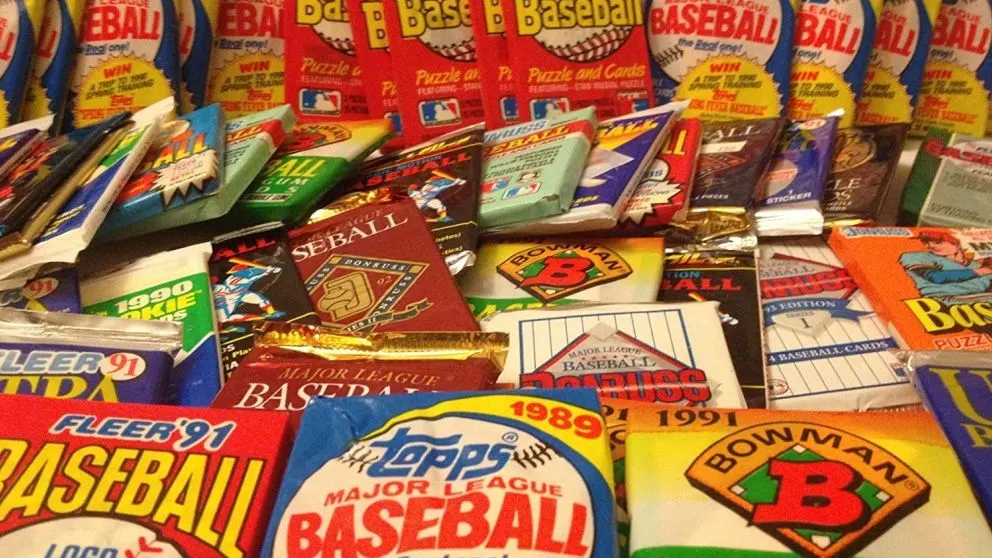
Baseball cards are among the most recognizable and most numerous pieces of sports memorabilia.
Collectors stubbornly hold onto rare cards as their value goes up, and many have spent years, or even decades, tracking down their favorite player’s rookie card.
The iconic images, detailed stats on the back, and showing off one’s cards to another collector are the simple pleasures of this popular hobby.
However, another kind of baseball collector never actually lays eyes on the cards he’s amassed.
These unopened packs are commonly known as ‘wax packs’ and have been steadily growing in value over the past few years.
What Are Wax Packs And Boxes?
Technicalities are essential in sports memorabilia, as we all know, so a more detailed definition of what counts as a wax pack is in order.
In the past, the most common packaging for packs of sports was wax paper, which protected the cards (and sometimes gum) without sticking to them.
However, ‘wax packs’ do not refer to this sort of packaging but to any pack of cards that has never been opened. Indeed, packs of cards that come wrapped in cellophane (also called ‘cellos’) can be called a wax pack if they’ve never been opened. Each pack usually contains between 10 and 20 individual cards. Wax boxes are unopened packages containing numerous packs of cards. The number a box holds varies more widely than the number of cards to a pack, but it can be anywhere from 12 to over 36. Breaking a pack is the name for opening a box or package to see the cards inside.
The Most Popular Wax Packs and Boxes
While there are countless wax packs out there, here are some of the most popular boxes to add to your collection.
- 1980 Topps-Baseball
- 1987 Fleer-Baseball
- 1989 Upper Deck-Baseball
- 1993 SP Upper Deck-Baseball
- 2011 Topps Update-Baseball
How Do You Know If Someone Has Opened a Packet or Box?
Since older packs of cards come sealed with wax, it is a possibility that someone has opened and resealed the pack by applying heat. That unethical person could’ve looked for and taken the valuable cards before trying to resell the pack as if they’d never opened it.
If you’re buying a wax pack or box online, it’ll usually have a Professional Sports Authenticator (PSA) score, especially if it’s rare and valuable. This certification will confirm that no one has ever opened the package and what the product’s quality is on a scale of 1 to 10.
If you’re buying cards in a storefront, it’s still a good idea to ask for a PSA certification. If one isn’t available, there are several clues you can look for yourself.
Anything on the pack that looks to be the result of tampering is evidence that someone has opened the pack. One of the biggest tells is broken gum in the pack. You can also look out for ripped or creased packaging, bent corners, and an imperfect shape.
How To Care For Wax Packets and Boxes
So, you’ve purchased a sealed pack of sports cards and want to hold off on opening it. It’s important to properly store the wax pack to ensure the box’s integrity.
Packs and especially boxes are a little bit less prone to damage than individual cards, but one still has to be careful. The most crucial factor to watch out for is temperature, which can have an impact on both the gum in the pack and the wax itself. Ensure the wax packs and boxes aren’t stored somewhere that gets too hot. Newer packs of cello wrappers are less vulnerable to warm temperatures.
Also, the boxes mustn’t have too much weight put on them, as this can make the cards inside the stick to one another.