
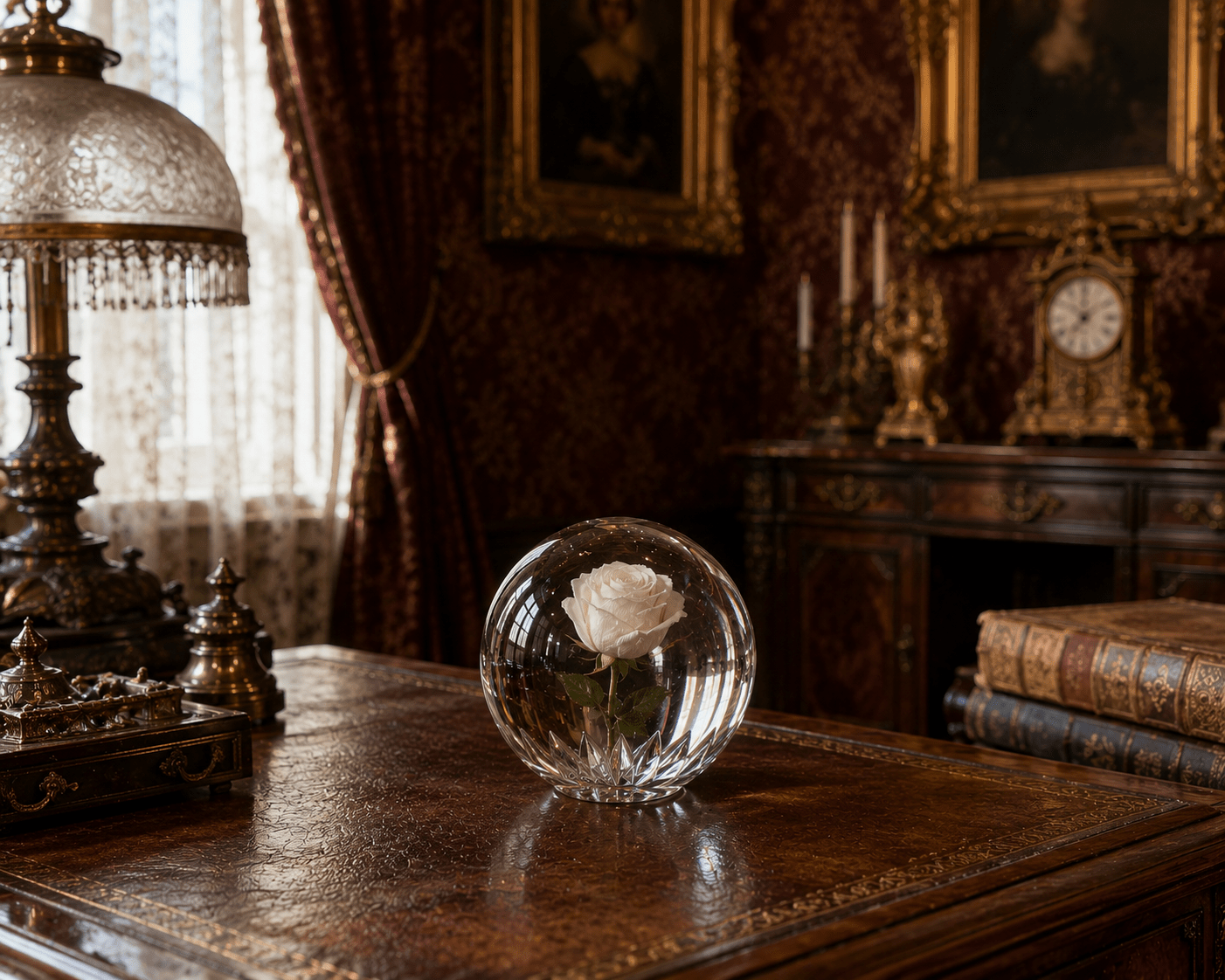
Royalty, Writers, and a White Rose in Glass: The Unlikely Obsession That Captivated Victorian Society
In 1948, a young Truman Capote found himself in a Paris apartment that looked less like a bedroom and more like the inside of a jeweler’s dream. Colette, the grande dame of French literature, was propped up in bed, nearly eighty years old and surrounded by perhaps a hundred glass paperweights covering two tables beside her. Capote later described what he saw as crystal spheres imprisoning green lizards, salamanders, and millefiori bouquets, shimmering like fireworks.
Colette picked one up and handed it to him. It was a Baccarat, a single white rose suspended inside clear glass. She asked what images it brought to mind. He said young girls in their communion dresses. She smiled, told him that was very charming and very apt, and gave it to him. He never put it down. When Capote died decades later, that same weight was on his bedside table.
The story of how glass paperweights became one of the most quietly coveted objects of the nineteenth and twentieth centuries runs through bedrooms and throne rooms and flea markets and auction houses, touching some of the most fascinating figures of the past two hundred years. It is not a story that gets told nearly enough.
The Fifteen Years That Made Everything
The paperweight as a serious art object has a remarkably compressed origin. The first documented examples appeared at the Exhibition of Austrian Industry in Vienna in 1845, where Venetian glassmaker Pietro Bigaglia showed small decorative weights that stopped visitors cold. Word reached the great French glasshouses almost immediately.
Saint Louis produced a dated weight the same year. Baccarat followed in 1846. Clichy, the third of the great French triumvirate, was not far behind. For roughly fifteen years these three factories competed with an intensity that produced some of the most technically demanding decorative glass objects ever made. Millefiori canes packed so densely you could spend an hour in a single piece and still find something new. Lampwork flowers accurate enough to identify by species. Sulphide portraits of emperors and heroes sealed under crystal like insects in amber.
The 1851 Great Exhibition at London’s Crystal Palace introduced this work to an international audience on a scale nothing had previously managed. Clichy alone had to bring on hundreds of additional workers to keep pace with the demand that followed. The paperweight had arrived, and it had arrived for the right people, meaning people with money, taste, and a Victorian fondness for beautiful objects that were also, technically, useful.
By 1860 the golden age was effectively over. The factories moved on. The pieces that existed were all that would exist, and the number was not as large as it sounds. An estimated 75,000 classic French weights were produced across that period. Perhaps 25,000 to 30,000 survived intact. Many of those sit in museum collections and never reach the market. The ones that do are not getting easier to find.
The Collectors Who Made Them Matter
The first wave of serious collectors were, predictably, the nobility. Queen Victoria collected them. So did Queen Mary. Empress Eugenie of France, wife of Napoleon III, was an ardent admirer, and the factories were not shy about capitalizing on that connection. Baccarat and Saint Louis produced sulphide portrait weights bearing her likeness, objects that today represent some of the most historically layered pieces a collector can acquire. Empress Carlotta of Mexico, wife of Maximilian I, was another devoted collector, and King Farouk of Egypt assembled a collection significant enough that when he was forced to abandon his throne, the fate of those pieces became a matter of genuine concern in collecting circles.
Oscar Wilde had them on his desk. Eva Peron kept them. Fashion designer Jeanne Lanvin collected them. These were not people who acquired objects casually.
What connected them was something more than wealth. The paperweight asks something of its owner that most decorative objects do not. It requires patience. You cannot appreciate it at a glance. You have to lean in, hold it up to the light, turn it slowly, let the interior reveal itself on its own terms. For a certain kind of mind, that quality is not a barrier. It is the entire point.
Colette and the Fever She Started
The French novelist Colette understood this better than almost anyone. She decorated her apartment in the Palais Royale almost entirely with paperweights, many of them found in Paris flea markets where, at least for a time, they could be had for next to nothing. She spoke about them with the intensity of someone describing a living collection rather than a decorative one. She once suggested she might take them with her in her coffin, like a pharaoh.
It was Colette who infected Capote, and Capote who spread the obsession through the American literary world in a way that no exhibition or auction catalogue could have managed. He hunted them at auction houses in Copenhagen and Hong Kong. He once found a weight worth four thousand dollars in a Brooklyn junk shop and paid twenty dollars for it. In East Hampton he successfully bid seven hundred dollars at auction for a millefiori piece he valued at seven times that. He called it an electrifying spectacle.
His description of paperweights as rather like frozen snowflakes, dazzling patterns frozen forever, became the most quoted line in the history of the form. It also captures something true. There is a particular quality to the experience of a great paperweight, a sense that something permanently arrested is being observed, that the flowers inside will never wilt and the bee will never land and the moment held in the glass is immune to everything time does to everything else.
The Paperweight Collectors Who Built the Scholarship
Alongside the famous names were the serious collectors whose obsession produced the body of knowledge that the market depends on today.
Evangeline Bergstrom, wife of a Wisconsin paper manufacturer, began collecting shortly after the turn of the twentieth century. Her 1940 book, Old Glass Paperweights, was the first major work on the subject in English and essentially created the framework through which collectors understood and valued these objects. Without Bergstrom, much of what is known about provenance and attribution in this field would not exist.
Arthur Rubloff, a Chicago real estate developer, approached collecting with the same systematic ambition he brought to everything else. He eventually assembled 1,472 paperweights, donating 1,200 of them to the Art Institute of Chicago in 1978. That collection was one of the most significant in the world and made the Art Institute a destination for anyone serious about understanding what classical French paperweights actually look like at their finest.
The Paperweight Collectors Association, founded in 1953, formalized a community that had been growing quietly for decades. Among its early members was Truman Capote, who brought a writer’s ability to communicate obsession to an audience that might otherwise never have encountered the form.
The first major auction dedicated to paperweights was held by Sotheby’s in 1925. Eighty-two weights sold for a total of $588, an average of roughly seven dollars each. That figure is worth sitting with for a moment. A Clichy Basket of Flowers from the classic French period sold at auction in 1990 for over $258,000. The market that existed in 1925 and the market that exists today are not the same conversation.
What the History Means for Glass Paperweight Collectors Now
The Victorian golden age produced a fixed supply of objects that is not going to increase. Every year some are damaged, lost, or absorbed permanently into institutional collections. The ones that come to market carry with them the full weight of that history, and for buyers who understand what they are looking at, they represent something that is genuinely not being made anymore.
Key names to know from that period include Baccarat, Clichy, and Saint Louis. Baccarat is recognized by its dated and initialed canes, its exceptional optical clarity, and the extraordinary precision of its lampwork florals. Clichy is known for its vivid color palette, its intricate millefiori, and the signature Clichy rose cane that appears in many of its finest pieces. Saint Louis, the first of the three to produce paperweights, developed a distinctive range of lampwork and millefiori patterns that serious collectors can identify with practice and the right reference material.
Condition and provenance are everything. A documented ownership history, particularly one that connects a piece to a significant early collection, adds both authenticity and narrative value. The pieces that arrive at auction with a clear story behind them consistently outperform those that do not.
The Object That Outlasted Everything
Colette kept her weights until she died. Capote kept his until he died. The Baccarat white rose that passed between them in that Paris apartment in 1948 survived both of them and everything that happened in the decades between.
That is the quality that keeps drawing collectors back to this form. Glass paperweights from the Victorian golden age were made to last, and they have. The world that produced them is long gone. The letter writing culture that made desk accessories a matter of social aspiration has vanished entirely. The factories that made them either closed or moved on to other things.
The weights remain. Fifteen years of competitive genius from three French factories, sealed in crystal, still waiting on desks and in display cases and at auction for someone to lean in and take a closer look.
Blue Box Auction Gallery’s upcoming paperweight auction includes a carefully selected range of collectible glass works. If you are considering consigning a piece from a Victorian-era collection or are looking to acquire one, we would welcome the conversation.
Recent Posts
Coin Authentication: A DIY Guide for Collectors
Preserving History: Expert Tips for Caring for Civil and Revolutionary War Militaria

Coin-Ops: Relics of Yesterday, Treasures of Today
All Categories
Sell With Confidence
Roger G. Jacobsen Paperweight Collection Part 1
8d 17h 10m 55s
The best auction finds don’t wait around.
Be the first to see what’s coming up—sign up for exclusive previews and expert insights.